
🟢 Now is the moment when AI is switching from invention to innovation
Smart TVs stripped of ads, banks blocking AI agents, unexplained outages in November 2026. AI is leaving invention and entering innovation, with second-order effects that nobody planned. A reading with my Big Technology Framework, and what it means for Europe.

October 2026 will mark the start of a critical transition for AI. A transition that couldn't be planned by OpenAI, Anthropic, or Google: first, the tech happened and was distributed with grandiose ideas of what it would do – nothing much happened in that regard, for now – then the second wave of improvised, bottom-up uses is just starting to show up in garages, homes, banks, farms, and small companies. Innovation is the time when tech changes society, and it has just started.
For a while, code was the only real AI innovation
Coding has been destroyed and rebuilt by AI tools first for (in hindsight) quite obvious reasons. See, a programming language has strict rules and enormous archives of public content. For large language models, it's the absolute combo. Statistical predictive LLM engines perform ideally, with little to no room for error, and tests can tell you within seconds whether the output works. Mathematics is now the other field where progress shows, and (still in hindsight) the root cause is the same: formal rules, an extensive written record, and highly testable outputs with strict right/wrong answers.
Outside of highly structured contexts (art, medicine, industrial processes...), the same model rapidly starts 'hallucinating'. A word I find misleading, since the model still produces a reliable, probable answer from the data it absorbed, as it always does, so we should blame the context it was used in rather than the tool itself... but I don't want to digress too much.
Second-order effects of AI are now just appearing
In October 2026, a developer named Gathin published CleanYourTV, a method that lets owners of a Google TV prompt a coding AI agent to connect to the set, switch off the spyware and bloatware, and install a simpler, faster launcher.
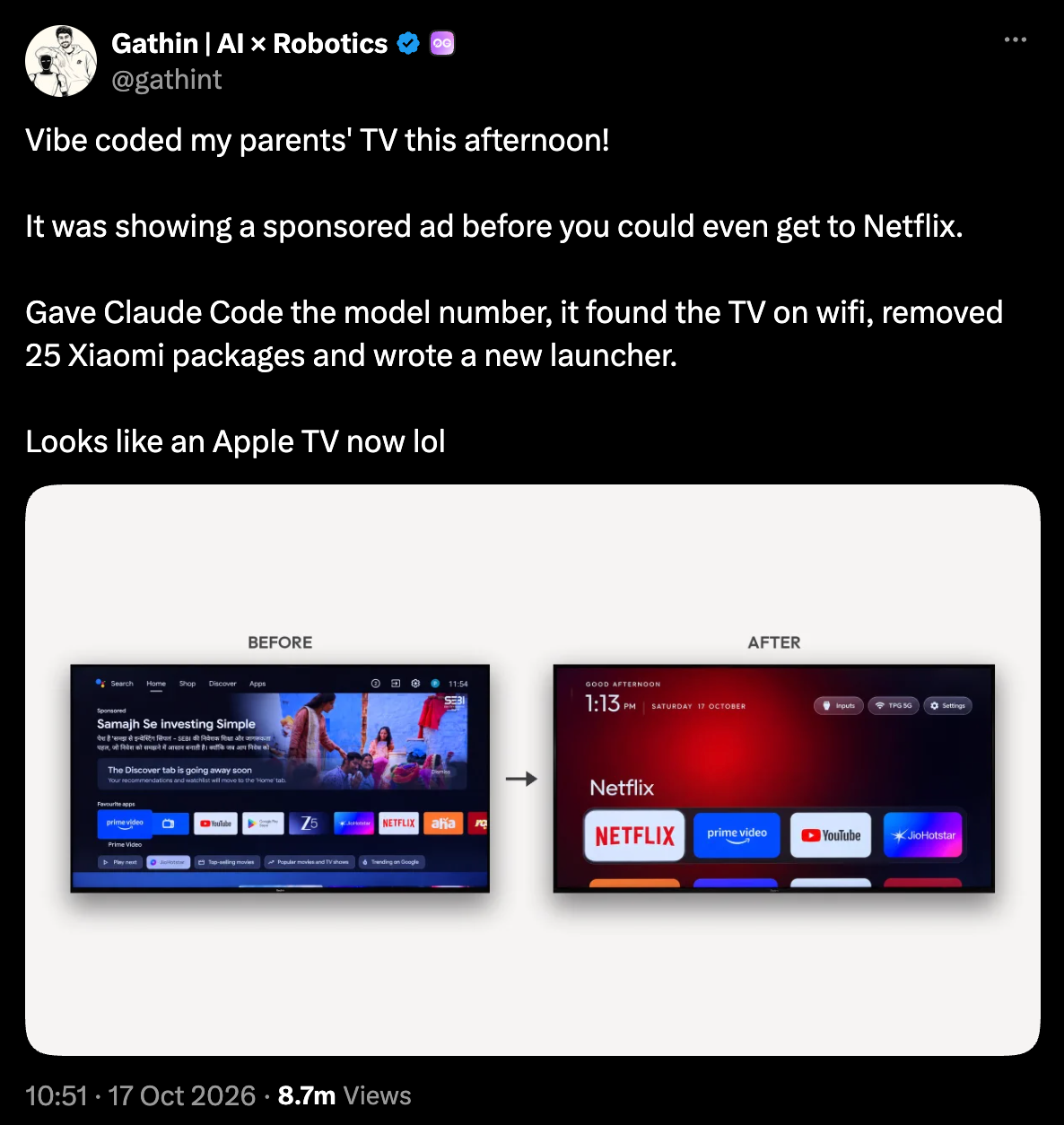
Only a few days after he published his prompt on GitHub, forty-five thousand people have since used this 'AI vibe coding' strategy to regain control of their TV.
Another developer published Toque, a replacement interface for a robot cooking device running the crappy Lidl Monsieur Cuisine Connect on its tablet. Within minutes, the poorly designed software is replaced with a lighter, more intuitive vibe-coded version that keeps the official recipes and installs effortlessly.
Sammy Azdoufal asked Claude Code to analyze the DJI app and the protocol of DJI robot vacuums, and he ended up with access to the floor plans and camera feeds of strangers’ vacuums, a loophole that DJI has since closed in its main parts.
Small companies behave in the same way. A Retool survey published in 2026 found that 35% of teams had already replaced at least one SaaS tool with a custom build, 78% expected to build more during the year, and some small Salesforce customers have moved to CRMs they coded with AI tools. Many companies also write small connectors that move data between their accounting software and other tools.
And the list goes on and on. Reverse engineering of closed devices is getting mainstream.
When incumbents push back, innovation has happened
In September 2026, the US NHTSA opened an investigation into Comma hardware kits, aftermarket openpilot driver-assist software installed by over 30,000 car owners, because of fears that inexperienced users will now modify openpilot with an unpredictable AI model (a risk nobody can measure yet).


