
🟢 Our Crossroad Analysis framework and AI-augmented consulting

AI-augmented consulting is a thing
I'm always late to share new tools or consulting formats we develop for customers, so let me catch you up on an important one.
Both scenario planning and bottleneck analysis have been center-stage in my practice for quite a few years. The first one is an adaptation of the full original methodology (let's be honest: one can rarely afford to use it fully), and the second one is a pure homebrew version of other strategy tools (which, again, are neat on paper but unusable in real-life scenarios).
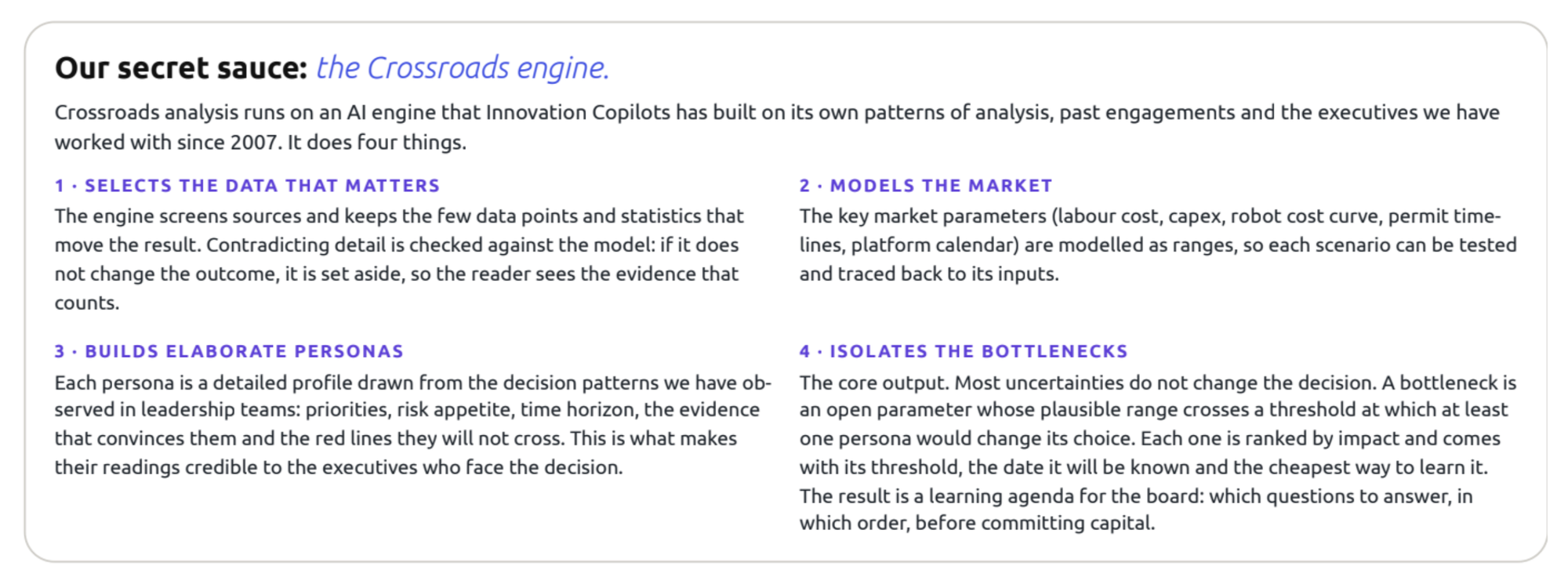
For the last year or so, I've been experimenting quite a lot with AI and, mostly, found what works for me or doesn't. The tool I'm going to share here is called Crossroad Analysis. What is interesting to me is that I would have done this five or six years ago as a full-day workshop, with several days of preparation, follow-up, debriefing, and verification. Now I can have a first version automated in about an hour or two, with 80% of the past insights and 'aha' moments.
And the trick here is that this is not just a prompt that any random junior consultant could produce – I mean, you can totally steal the recipe, as I'm going to share it right away, but you won't have access to what really feeds the pertinence and discriminative power – but it's really about two decades of experience, a formatted mindset, and directional insights, distilled into an AI framework.
The AI part still surprises me to some extent (read on about the personas involved), but within the constraints of the task they've been precisely assigned to. Just like in real life, I would be able to direct the critical thinking of a CEO, CFO, and CTO team. For me, this is an exciting time and a fine balance. Using critical, personal knowledge and giving directed freedom to AI models within the scope.
What is crossroads analysis?
Crossroads analysis is our method for decisions on which reasonable executives disagree.
It is based on three AI personas. Each persona is a defined decision stance given to an AI model: a set of priorities, a reference scenario, and decision criteria. This is a form of divergent analysis: instead of producing one blended recommendation, the personas sit at the edges of the range of reasonable executive positions, making the decision envelope visible.
The approach has four steps:
- Common base. We start with one model of both options and one set of public benchmarks, with different scenarios.
- Divergence. Each persona reads the results with its own stance, assumptions, and criteria, and then takes a position.
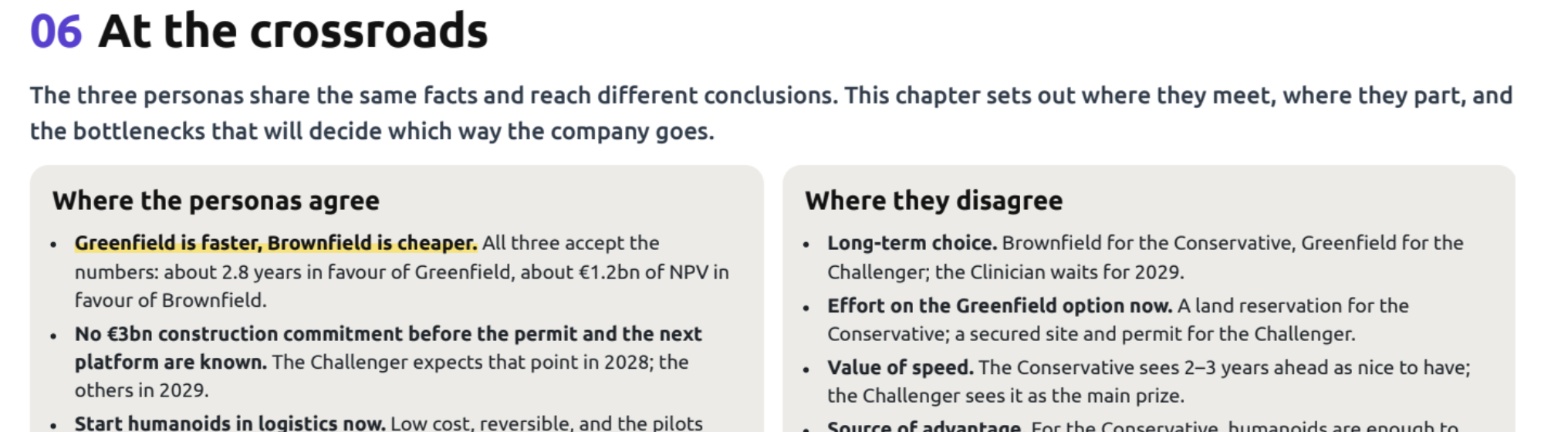
- Overlap. Points where all three agree are treated as robust conclusions, while points where they part are treated as matters of judgment for the board.
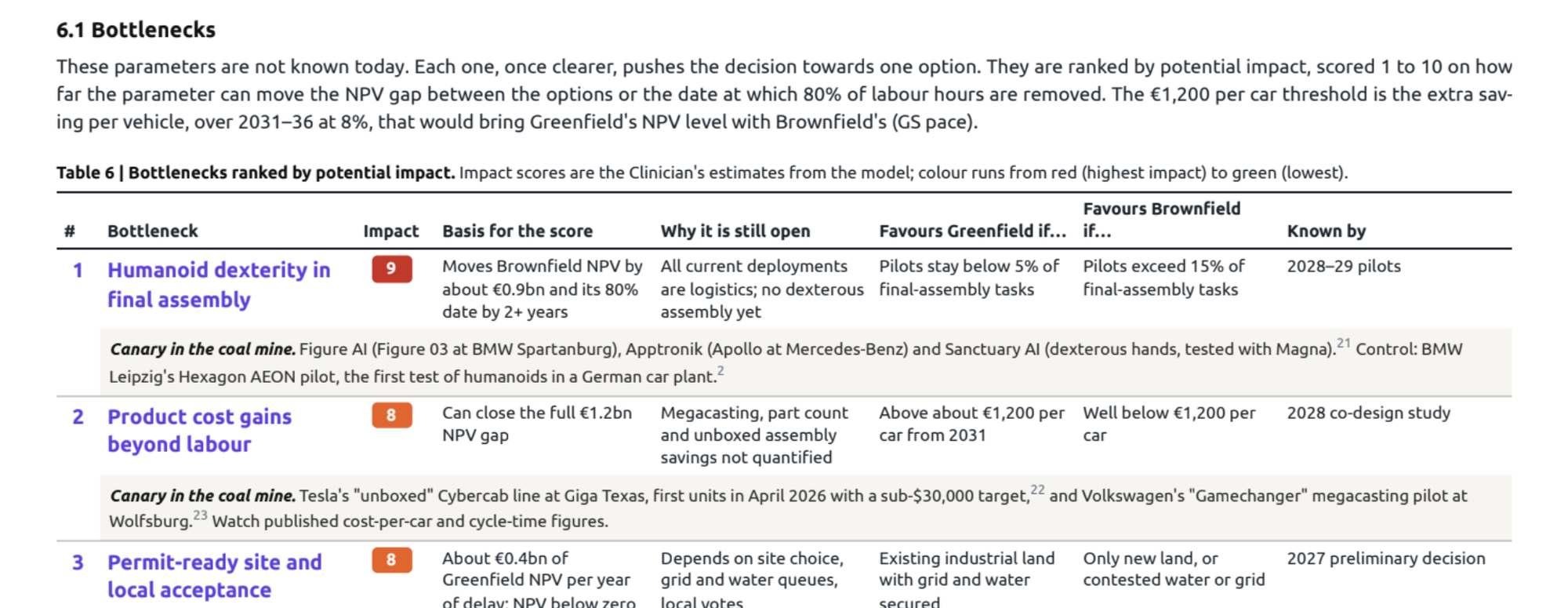
- Bottlenecks. The key deliverable in most cases: the open parameters that move the decision from one edge of the envelope to the other are listed and ranked by impact.
The personas do not forecast what a given executive would decide, and they do
not try to replace the board's judgment. Rather, they make explicit how the same facts lead to different conclusions depending on the weight given to risk, speed, and capital.
Outputs for sharp decision-making
What you get is:
- A one-page synthesis.
- The main facts scenarized as a clear business case.
- The three persona readings (the same data read by a neutral, a risk-averse, and a growth-minded executive, each with its position, arguments, and criteria)
- The shared first move, if it exists.
- A map of agreement and disagreement (what holds whatever the stance,
and what is a matter of decision-making for the board). - A ranked bottleneck watch-list. For each open parameter: its impact, the
threshold that would tip the decision, the date it will be known, and the
companies, rules, or events to watch.
Why it works
Divergence comes before convergence.
While most strategy work averages views into one recommendation and hides the trade-off, here setting three personas at the edges of the decision envelope makes the trade-off explicit because personas carry real decision patterns. They are built on how leadership teams actually weigh risk, speed, and capital, so their readings sound familiar to the people who will decide.
And key uncertainties are translated into an effective monitoring plan. The bottlenecks turn "we do not know yet" into a short list of what to measure, by when, and what result would change the decision:
Download a full example here:
Here, the case is about whether European carmakers should bet on humanoid robots ('brownfield factory retrofit') or on new fully automated plants ('greenfield black boxes'):
(Link is for our Premium Subscribers only.)


