
The Ferrari Luce is an innovation story, just not a very good one
The outcry about the Luce's design is understandable. What it reveals about Ferrari's strategy is more interesting, and considerably more damning.
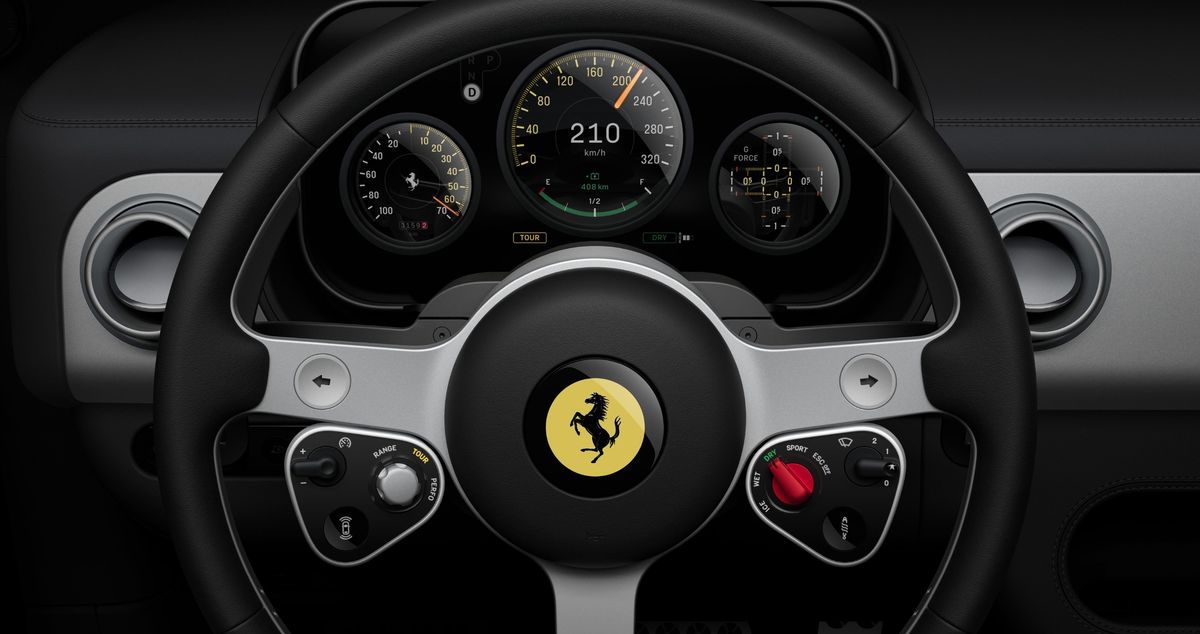
Ferrari unveiled its first fully electric production car, the Luce, on May 25, 2026, priced at €550,000. Within 24 hours, Ferrari's stock had dropped entirely. Former chairman Luca di Montezemolo, who now sits on the board of rival McLaren Group, said publicly that the company "risks the destruction of a legend." Italy's deputy prime minister posted on X that the car "looks like anything but a Prancing Horse." An Oddo BHF analyst called it "by far the sharpest reaction we've ever seen for a car design."
And yet most of the commentary, the memes, the outrage, the nostalgic hand-wringing, is focused on entirely the wrong question. The Luce is not a design failure. It is an innovation story, albeit one that Ferrari has handled with a degree of strategic incoherence that should concern anyone who thinks seriously about how large companies manage brand transitions.
Getting physics and engineering right
The first thing to understand about the Luce is that its proportions are not a stylistic choice so much as an engineering constraint. The car carries a 122kWh battery pack; all modules sit between the front and rear axles, with the majority positioned as low as possible within the chassis. The battery alone weighs 630kg, integrated into the car's floorpan and assembled in Maranello. When you build around an underfloor battery of that mass and footprint, the body sitting above it cannot be low-slung, compact, or close to the ground as a combustion-engined Ferrari has traditionally been. The physics simply doesn't allow it.
Ferrari's own head of vehicle engineering, Matteo Lanzavecchia, acknowledged this directly: "If you have a mid-engined car and you remove the engine and fuel tank and replace them with a battery pack and electric motor, you're not gaining anything in terms of center of gravity or the moment of inertia." So Ferrari made the only possible engineering call: build upward, accommodate five seats, and treat the battery constraint as a design brief rather than an obstacle to disguise. Unlike many manufacturers that convert existing combustion models into EVs, Ferrari developed the Luce from a completely new platform. That decision is, on its own merits, the right one.
For an everyday car, a Tesla Model S, a Porsche Taycan, or a BYD Han, this architecture works beautifully and opens up genuine interior creativity. The battery floor becomes an asset: flat cabin, low center of gravity, generous headroom. But for a brand whose identity is built on aggressive low-slung silhouettes and the physical sensation of being pressed into the tarmac? It is a much harder sell.
The constraint that is invisible in a €50,000 EV becomes the dominant conversation in a €550,000 Ferrari, because the audience knows, with great precision, what a Ferrari is supposed to feel like from the outside.
The brand is the product
There is a recurring argument in the defense of the Luce which goes roughly as follows: the people complaining about the design cannot afford one, so their opinions are irrelevant. This argument is wrong, and it is wrong in a way that matters strategically. Ferrari's brand equity, which is what justifies a €550,000 price tag for a car that, by objective performance metrics, competes with machines costing a third as much, is built almost entirely on aspiration. It depends on the desire of people who will never own one to give status and bragging rights to the very few who can afford it. To a large extent, the man or woman who sees a Ferrari on the street and feels a specific kind of envy is doing the real economic work for the brand.
A brand embodies your market's tacit and explicit expectations about what you deliver, and the more powerful your brand, the more difficult it becomes to reposition.
The problem with the Luce is not that it is electric. Porsche made the transition to the Taycan with relatively contained brand damage because the Taycan still reads as a Porsche, the proportions, the stance, the visual grammar of the 911 family inflected into something new. The Luce reads as something else entirely. The car's unveiling prompted one market analyst to describe it as "a mix between a Honda Accord EV and a Tesla Model S." That comparison, however unfair in engineering terms, is fatal in brand terms. It is the exact reverse of what a Ferrari is supposed to make people feel.
The mastermind plan theory
All that being said, there is a legitimate strategic logic available to Ferrari; it just requires the company to have actually intended it. One can imagine a Ferrari that decides, with clear eyes, to stop competing in the segment of loud, aggressive, low-volume supercars and to target a different form of extreme luxury: the rich technologist in San Francisco or Singapore who wants a designed object of genuine rarity, collaborative between Italian craft and the world's most celebrated product designer. The Luce's design was produced by LoveFrom, the creative collective founded by Jony Ive and Marc Newson. That is a credible cultural signal for a specific audience, one that doesn't overlap much with the audience that mourns a departing V12.
The problem is that market repositioning of this kind is innovation in the most rigorous sense of the term: it requires changing the expectations of a new market while managing the exit from an old one, and it requires a visible and consistent intent that the market can read and evaluate.
As I have argued before in examining the Osborne Effect and the risks of self-cannibalization, the moment you announce a fundamental shift, you begin eroding the existing business, which means the new market had better be ready to catch you. There is no evidence that Ferrari has built that catch. The car was not presented to a new target demographic, nor introduced in a market geography where wealthy EV adopters are concentrated like... Norway. The communications strategy was built entirely around secrecy and spectacle, which is the Ferrari playbook for a new supercar, not the playbook for a brand repositioning. If you look at how this compares to a roadmap for genuine market disruption, a key signal of a deliberate strategic move is that the intent is legible, at least partially, to the new market you are trying to reach.
The Luce gives that market (if there's actually one) no legible signal. The new customers Ferrari might theoretically be courting have no particular reason to understand that this car was made for them, rather than being a strange detour made by a brand that usually makes very different things.
Brand gravity and the cost of ambiguity
The deeper strategic problem is one I would describe as brand gravity: the tendency of a powerful brand to pull every product decision back toward the expectations that created it. When your brand anchors you to a market position, moving away from it is not simply a communications challenge; it is an architectural one. BMW's i3 suffered a version of this problem: a genuinely interesting urban EV that BMW's existing audience didn't want and whose target audience didn't immediately associate with the BMW proposition. Ferrari's situation is more acute because the brand's anchoring effect is more total. There is arguably no brand in the automotive industry where the gap between "what this badge means" and "what this car looks like" is wider than with the Luce.
Then again, we can go back to the strategic-move argument and trust that Ferrari is playing a very long game, that the Luce is an investment in brand evolution over a decade, and that short-term stock reactions are noise.
This would be more persuasive if Ferrari were in a position of comfortable financial strength. The broader luxury EV segment is facing meaningful headwinds, with Porsche and Lamborghini both scaling back electric ambitions in response to weaker demand, while Chinese manufacturers are exerting sustained pricing pressure on European brands in the EV space. A decade-long repositioning requires either very deep pockets or very clear early signs of traction in the new market.
Ferrari has shown neither.
There is no innovation without a theory of change
The Luce is, in certain respects, an impressive engineering achievement. Ferrari engineers claim the handling is surprisingly close to a 296 GTB despite the car's size and weight, and the battery architecture is already designed to support future-generation cells that don't yet exist commercially. If you stripped off the badge and the history and presented this car as the product of a well-funded European EV startup with a talented design partner, the press would have been considerably warmer.
The issue is precisely that the badge cannot be stripped off, and Ferrari has given no coherent account of why it should remain.
As an innovation strategist, what I find missing is not courage, the Luce is, in its own way, a bold object, but a theory of change. Innovation at the market level, which is what a brand repositioning represents, requires a legible argument about which customers you are now serving, what they value, and how you intend to signal that value to them. Ferrari produced a car that its existing customers don't recognize as theirs, without establishing a new audience that recognizes it as theirs either.
Ambiguity at scale and at this price point is very expensive.
 Philippe MEDA

 Philippe MEDA

 Philippe MEDA